
Bazi charts
Four Pillars, luck cycles, annual influences, Ten Gods and hidden stems — the whole chart in one view.
Professional practitioners’ experience rules · AI only translates
Changing jobs, picking a date, naming a baby — bring your question. Bazi, Qimen, date selection, handwriting and Liu Yao in one Android app: charts follow fixed rules, you can keep asking follow-ups, and reports stay saved.
Basic charts are free. Handwriting and Liu Yao each include one complete free trial. Use features in the Android App. This website provides guides and downloads, with no in-browser charts or AI chat.
Check costs, features and saved records →
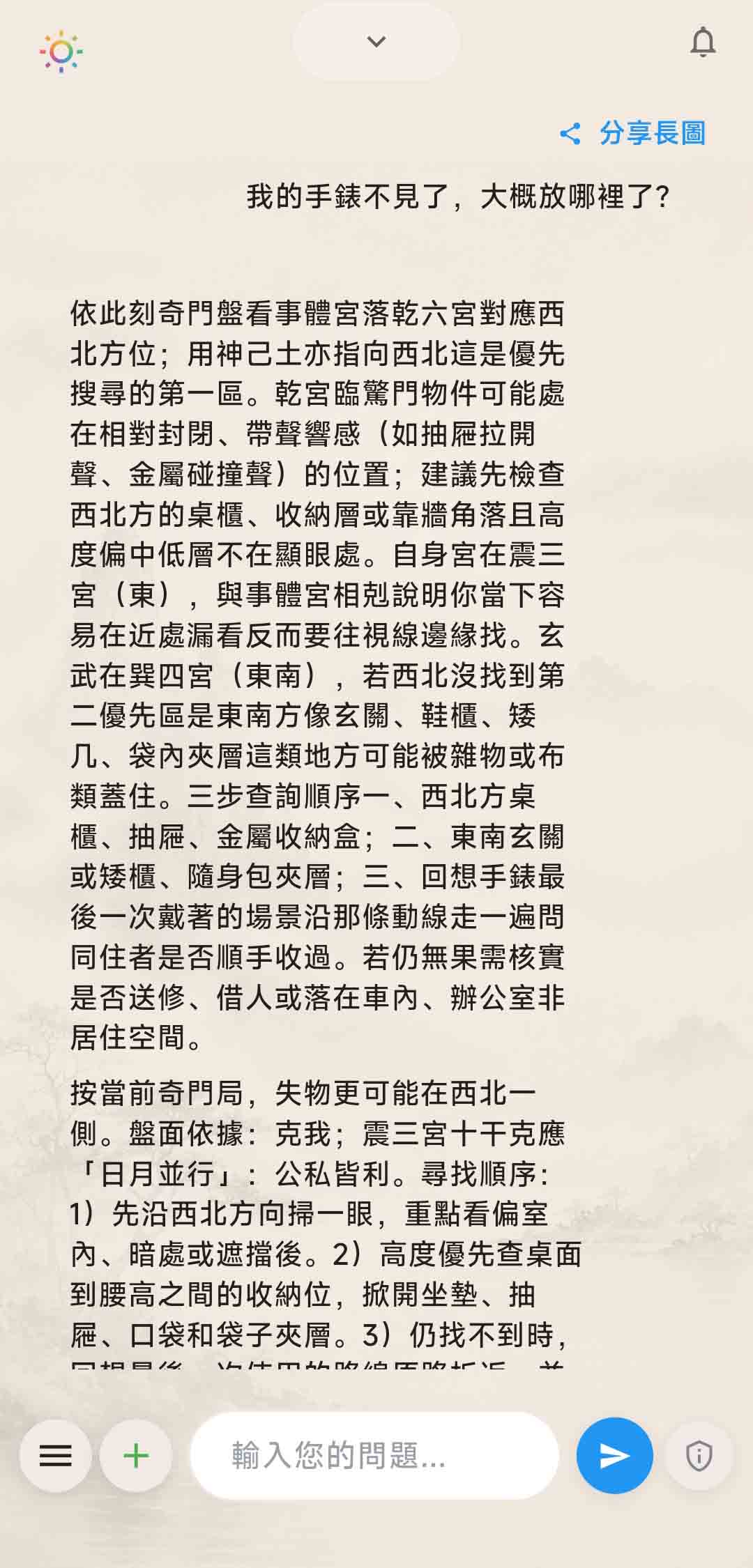
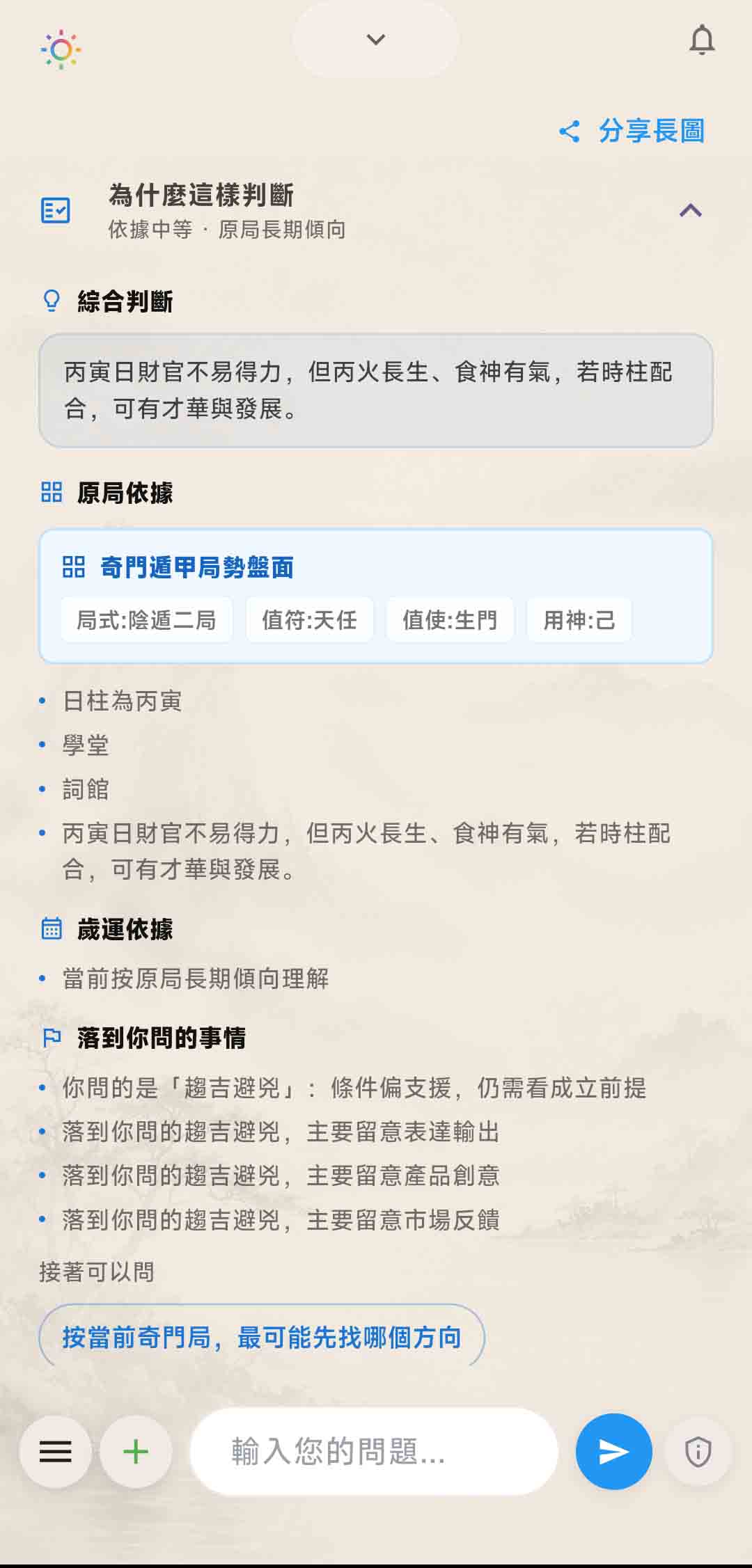
Pick a scenario. These are real App screens and example analyses — select any image to enlarge it.
Write down your question, review the analysis of roles, palaces and timing, then weigh the next step against your real situation.
The three main tools are below; open the rest as needed. Judgments come from the rule library; AI only explains them, and explanations can be wrong.
Four Pillars, luck cycles, annual influences, Ten Gods and hidden stems — the whole chart in one view.
One specific question: chart roles, useful gods and palaces for timing and direction.
Filter days by occasion, place and orientation; get candidate dates and time windows.
Confirm pronunciation first, then meanings, Kangxi strokes, numerology and Bazi references; save candidates. Mandarin Chinese-character names for now.
Write one character by hand and attach one specific question. The report covers the handwriting observations and traditional character examples.
Coins, manual entry or time-based casting. Read the hexagram analysis and action references; no lottery predictions.
Ask about the current chart, keep following up, open the reasoning anytime.
Keep family charts separate, switch and compare, and pick your explanation preference.
Unsure of the birth hour? Check candidate times against life facts you confirm. It’s inference, not a birth record.
Unlike typical AI fortune-telling apps, the judgments here don’t come from a model improvising. Behind the app is a rule library: professional practitioners turned years of judgment methods and their conditions into rules, one at a time.
The experience comes from professional practitioners and peers at 蔡伯励书院, 文昇书院, 广东易学协会 and 中華民國星相學會 (Taiwan).
Years of professional practice become methods, conditions and analysis points, written into rules.
The applicable rules run against the current chart or tool inputs — the reasoning happens here.
No part in the metaphysical reasoning — it puts the rule findings into an explanation shaped around your question.
One question isn’t the end: the chart, the explanation and the record all stay in the app.
The chart data sits next to the explanation. Open the reasoning to see where it comes from.
It remembers the current chart and what you’ve confirmed. Add one detail and the question gets sharper.
Charts and completed reports are kept with the original question and context — no need to generate them again.
How to pick a tool, what it costs, and what happens to your records.
For your chart and the years ahead, start with Bazi. For one question right now, use Qimen, handwriting or Liu Yao. Look at the inputs and examples first.
Read the guide →No. Plans have credit and feature limits; handwriting and Liu Yao are counted separately, and some reports are bought on their own. Checkout prices apply.
Read the guide →Line up the date, clock time, place, time zone and calculation conventions before comparing. Here the judgments come from a rule library built by professional practitioners; AI only translates the findings into explanations and doesn’t do the reasoning. Check chart and explanation separately — persuasive wording proves nothing.
Read the guide →Find the original record and order, then retry the same task instead of creating a new one. Completed handwriting and Liu Yao reports reopen free. Before switching phones, check the account and channel — records don’t necessarily follow automatically.
Read the guide →Six feature walkthroughs: what you enter, what you see, what it costs and what comes next. The illustrations are made by this site and use no real user data.
See a workflow →Daily conversations, frequent questions or a single report — different choices. Alipay in China, Google Play elsewhere. International prices are references; checkout applies.
For regular conversations and getting to know your chart.
US$3.99 / month
China: CNY 19.9 / month
120 monthly conversation credits
3 handwriting + 3 Liu Yao reports per month
Reply styles, school preferences, multiple charts and birth-time tools
For frequent questions, date selection and the full reasoning.
US$7.99 / month
Annual reference: US$59.99 · China: CNY 49.9/month or CNY 398/year
500 monthly conversation credits
10 handwriting + 10 Liu Yao reports per month
Detailed explanations, Tianxing date selection and Qimen tools
One question, one complete report.
US$1.99 / report
Reference price per handwriting or Liu Yao report; China: CNY 6.9 each
One complete free trial per feature
Then use the separate allowance or buy a report
Revisit completed reports without another generation charge
Handwriting and Liu Yao each include one complete free trial. After that, each uses its own membership count; when it runs out, buy a single report: CNY 6.9 in China, reference USmembership_reports_p:.99 elsewhere. Counts refresh monthly in Beijing time, don’t roll over, and stay monthly on annual plans. Neither uses conversation credits. Failed generation restores the count or entitlement — retry with the original question, handwriting or hexagram. What’s restored is the count, not an automatic cash refund. Completed reports reopen free; deleting one doesn’t refund its count. Other detailed reports are bought separately per the in-app pricing.
Traditional rules for charts, AI for explanations
Bring one real question
The reading offers a perspective; the decision stays yours
A perspective and a reference — never the decision for you
Basic charts are free — try first
guanshizhili.top · Traditional-cultural reference only
You can stop the app from restoring past conversations, leaving less on the phone.
Manage records, clear local data or delete your account. Note: clearing the phone isn’t deleting the server, and deleting a report doesn’t refund its count.
For health, legal or investment matters, follow professional advice — not a reading.
Neither rules nor AI guarantee outcomes. A chart doesn’t decide how your life goes.
How to fill the inputs, pick a feature and read the results — it’s all written down.
Distinguish Bazi calculations, readable analysis explanations and AI-generated text, with a practical review process for Guan Shi Zhi Li.
How to frame a Qimen question, confirm its context and review chart-based explanations in Guan Shi Zhi Li without treating them as guarantees.
Understand date-selection inputs, local time, orientation, participant information and the distinction between Tianxing and Tianxin Zhengyun in Guan Shi Zhi Li.
Written from the current App’s features and charging rules. Your installed version and in-App pages determine availability and entitlements.
One Android app: Bazi charts with AI dialogue, Qimen questions, Tianxing date selection, Chinese name analysis and naming, handwritten-character analysis, Liu Yao, birth-time review, plus multiple charts and explanation preferences. Some date-selection versions also include Tianxin Zhengyun — it depends on your installed channel and version. Features run in the installed Android App; this website has no in-browser charts or AI chat.
The app currently has Simplified Chinese, Traditional Chinese and Korean interfaces — no English yet. This English website is a product guide. Name analysis and naming support Mandarin Chinese-character names; a Korean interface doesn’t mean Korean-name rules.
Gregorian, lunar, or an existing Four Pillars chart for reverse lookup — all work. After entering, double-check the date, clock time, place and time zone: one wrong hour shifts the whole chart. Don’t force-fill information you’re unsure of.
Yes. Tools like handwriting and Liu Yao don’t need full birth details, so start there. Birth-time rectification checks candidate hours against life facts you confirm; unknown facts can be skipped. It’s traditional inference — it can’t recover the true time or replace a birth certificate.
The experience comes from professional practitioners and peers at 蔡伯励书院, 文昇书院, 广东易学协会 and 中華民國星相學會 (Taiwan). The rules do the metaphysical reasoning: which classical methods hold and what they conclude for this chart. AI doesn’t take part in that reasoning — it only translates the rule findings into language you can read and follow up on. Calendar, chart and hexagram data are fixed computations — the same input gives the same result. The AI’s translation can miss or skew things, and regenerating changes the wording. The reasoning shown is about rules and data, not the model’s full private thought process. Stable calculation doesn’t mean accurate prediction of real events.
For the bigger picture — character, luck cycles, the years ahead — use Bazi. For one thing right now, like a job change or a negotiation, use Qimen. Both are references, not guarantees of real-world outcomes.
Usually the occasion, date range, place and time zone; add orientation for activities that involve it, and the person’s Bazi is optional. You get candidate dates, local time windows and the reasoning. If information is missing or no day fits, it says so honestly — no forced picks. For fixed dates like exams, official arrangements come first.
No. Tianxin Zhengyun is a separate rule-based tool inside the date-selection area, distinct from the Seven Governors and Four Residuals calculation. It currently covers five activity types: residential construction, burials, ancestral halls, moving and weddings, with stated limits on some rules. Availability and scope follow your installed version.
Confirm the name and any ambiguous pronunciations first, then review meanings, Kangxi strokes, numerology and Bazi references; candidates can be saved. Name analysis costs 2 conversation credits per use; naming is free. Mandarin Chinese-character names are supported. A name is a cultural reference, not a promise of changed outcomes.
Because it reads what you actually wrote: the shape, components, strokes, speed and pauses, matched with traditional character examples for your question. Typing carries none of that. Handwriting observation and cultural interpretation are separate things — it’s not a psychological diagnosis or identity check. The first complete trial is free; later reports use your count or a purchase.
Coins, manual entry or a time-based method — all three work. No birthday needed: Liu Yao reads your question and the hexagram. The report has five parts: response, key points, hexagram analysis, timing references and action references. Without timing evidence it makes no timing claims, and it doesn’t predict lotteries.
Basic charts are free; handwriting and Liu Yao each include one complete free trial; naming is free. AI dialogue and some analyses use credits, and different actions cost different amounts — so credits aren’t a fixed number of messages or unlimited reports. The app shows a charge confirmation each time.
In China: Standard is CNY 19.9/month with 120 monthly conversation credits, 3 handwriting and 3 Liu Yao reports; Pro is CNY 49.9/month or CNY 398/year with 500 credits, 10 reports each, plus full reasoning, Tianxing date selection and Qimen tools. Google Play reference prices: US$3.99/month, US$7.99/month, US$59.99/year — actual currency, price and tax follow checkout. Membership doesn’t make every report unlimited.
Neither. They’re counted separately: Standard gives 3 each per month, Pro 10 each, refreshing monthly in Beijing time — annual plans stay monthly too. They don’t use conversation credits. When a count runs out, buy a single report: CNY 6.9 each in China, reference US$1.99 on Google Play, per checkout.
No. A failed generation restores that count or purchase entitlement; retry with the original question, handwriting or hexagram and the original order. Don’t create a new task — that’s not a retry. What’s restored is the count, not an automatic cash refund; other tools like birth-time books follow their own pages’ terms.
Completed handwriting and Liu Yao reports reopen free, and saved birth-time books open from their feature. Deleting doesn’t refund the count, and creating a new task isn’t a free reopen. Decide whether you still need it before deleting.
In China, use the website’s direct APK (an arm64 build is also available) and pay with Alipay. Elsewhere, install, update and buy through Google Play. Features and released versions can differ by channel, so each channel’s listing applies. Overseas, prefer Google Play where available; the local store decides.
Privacy mode stops the app from restoring past conversations, leaving less on the phone. Clearing local records only removes what’s on the device — server-side account data stays until you go through account deletion. Online interpretation processes the needed data under the privacy policy; the app isn’t fully offline. Cultural readings don’t replace medical, legal or investment judgment.
Entitled dialogue can use Lu Ming Zi Ping or Mangpai Xiangfa: Zi Ping reads the day stem, month, structure and favorable factors; Mangpai reads stem-branch interactions and imagery. Switching affects later dialogue only — past answers aren’t rewritten. Bazi analysis reports use Zi Ping consistently; Liu Yao and Seven Governors tools are their own methods, not all Zi Ping.
Yanming Jianpi is a natal reading from the Seven Governors and Four Residuals system — not date selection. Its sources are the Xing Du Zhi Nan compilation, supplemented by applicable Guo Lao Xing Zong material. It’s a separate purchase at the five-year report price, not included in membership: reference CNY 69.9 in China, US$14.99 overseas, per checkout. Older installs may not have the entry. Completed reports reopen; failures retry with the original order.
Bring a question you actually care about and see whether the input, explanations and saved reports work for you. Then decide on membership or a single report.